Vascularized Immunoprotective Biomaterials as a Platform for β-Cell and Islet Replacement Therapy in Diabetes: Mechanisms and Translational Potential
DOI:
https://doi.org/10.22034/JATE.2026.244Keywords:
Islets of Langerhans, Diabetes Mellitus, Type 1, Tissue Engineering, Biocompatible Materials, Neovascularization, Physiologic, Immunomodulation, Cell- and Tissue-Based Therapy, HydrogelsAbstract
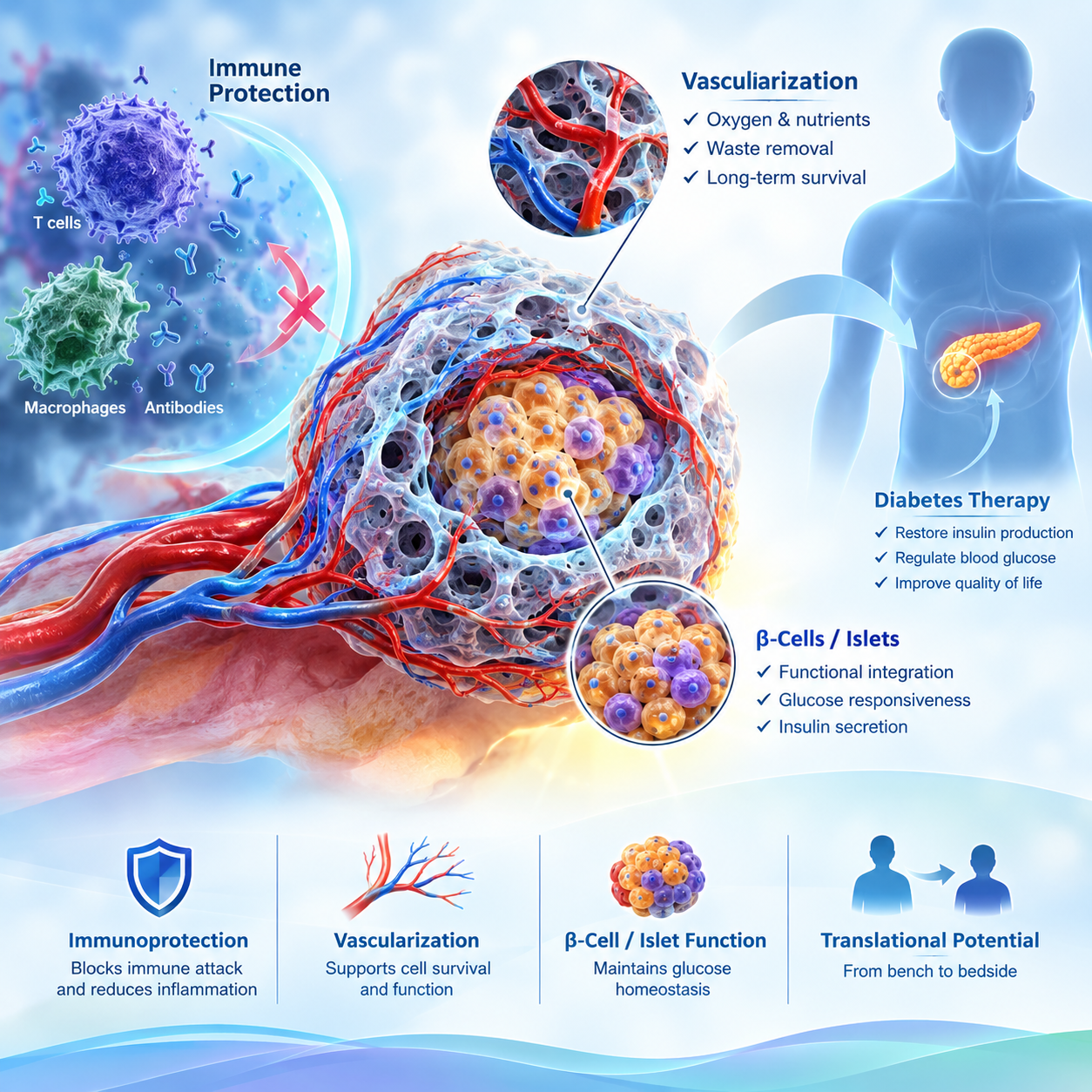
Islet and β-cell replacement can restore physiological insulin secretion in type 1 diabetes, but donor scarcity, chronic immunosuppression, and the fragility of avascular grafts have kept the approach from becoming routine therapy. Biomaterial engineering has approached these problems from two directions historically treated as separate traditions: immunoisolation, which shields transplanted cells behind a permselective barrier, and vascularization, which restores the oxygen and nutrient supply lost when islets are stripped of their native microvasculature. This review argues that the two goals are mechanistically coupled, because the same barrier properties that exclude immune effectors also constrain the oxygen diffusion on which β-cell survival depends. We examine the biological barriers to graft survival, the determinants of islet revascularization, and the principal classes of immunoprotective biomaterials (macroencapsulation devices, microcapsules, nanothin conformal coatings, hydrogels, and decellularized matrices) with attention to the trade-offs each imposes between permeability, mechanical durability, and immune exclusion. We then synthesize emerging platforms that engineer vascularization and immunoprotection together: pro-angiogenic and oxygen-generating materials, prevascularized and device-less sites, and local immunomodulatory strategies designed to substitute for systemic immunosuppression. Evidence is graded from mechanistic and rodent studies through non-human primate and clinical data, and we discuss why encouraging preclinical results have translated unevenly into durable clinical benefit. We conclude that no single material property solves this problem in isolation; durable, immunosuppression-free β-cell replacement will likely require materials engineered simultaneously for vascular integration, immune modulation, and manufacturable reproducibility, alongside renewable stem-cell-derived cell sources.
References
Sun H, Saeedi P, Karuranga S, et al. IDF Diabetes Atlas: Global, regional and country-level diabetes prevalence estimates for 2021 and projections for 2045. Diabetes Res Clin Pract. 2022;183:109119.
Shapiro AMJ, Ricordi C, Hering BJ, et al. International trial of the Edmonton protocol for islet transplantation. N Engl J Med. 2006;355(13):1318-1330.
Hering BJ, Clarke WR, Bridges ND, et al; Clinical Islet Transplantation Consortium. Phase 3 trial of transplantation of human islets in type 1 diabetes complicated by severe hypoglycemia. Diabetes Care. 2016;39(7):1230-1240.
Bennet W, Groth CG, Larsson R, Nilsson B, Korsgren O. Isolated human islets trigger an instant blood-mediated inflammatory reaction: implications for intraportal islet transplantation as a treatment for patients with type 1 diabetes. Ups J Med Sci. 2000;105(2):125-133.
Papas KK, Bellin MD, Sutherland DER, et al. Islet oxygen consumption rate (OCR) dose predicts insulin independence in clinical islet autotransplantation. PLoS One. 2015;10(8):e0134428.
Jansson L, Barbu A, Bodin B, Drott CJ, Espes D, Gao X, Grapensparr L, Källskog Ö, Lau J, Liljebäck H, Palm F, Quach M, Sandberg M, Strömberg V, Ullsten S, Carlsson PO. Pancreatic islet blood flow and its measurement. Ups J Med Sci. 2016;121(2):81-95.
Colton CK. Oxygen supply to encapsulated therapeutic cells. Adv Drug Deliv Rev. 2014;67-68:93-110.
Carlsson PO, Palm F, Andersson A, Liss P. Markedly decreased oxygen tension in transplanted rat pancreatic islets irrespective of the implantation site. Diabetes. 2001;50(3):489-495.
Suszynski TM, Avgoustiniatos ES, Papas KK. Oxygenation of the intraportally transplanted pancreatic islet. J Diabetes Res. 2016;2016:7625947.
Anderson JM, Rodriguez A, Chang DT. Foreign body reaction to biomaterials. Semin Immunol. 2008;20(2):86-100.
Coronel MM, Geusz R, Stabler CL. Mitigating hypoxic stress on pancreatic islets via in situ oxygen generating biomaterial. Biomaterials. 2017;129:139-151.
Razavi M, Primavera R, Kevadiya BD, Wang J, Buchwald P, Thakor AS. A collagen based cryogel bioscaffold that generates oxygen for islet transplantation. Adv Funct Mater. 2020;30(15):1902463.
Pepper AR, Gala-Lopez B, Pawlick R, Merani S, Kin T, Shapiro AMJ. A prevascularized subcutaneous device-less site for islet and cellular transplantation. Nat Biotechnol. 2015;33(5):518-523.
Weaver JD, Headen DM, Aquart J, et al. Vasculogenic hydrogel enhances islet survival, engraftment, and function in leading extrahepatic sites. Sci Adv. 2017;3(6):e1700184.
Veiseh O, Doloff JC, Ma M, et al. Size- and shape-dependent foreign body immune response to materials implanted in rodents and non-human primates. Nat Mater. 2015;14(6):643-651.
Vegas AJ, Veiseh O, Gürtler M, et al. Long-term glycemic control using polymer-encapsulated human stem cell-derived beta cells in immune-competent mice. Nat Med. 2016;22(3):306-311.
Jiang K, Weaver JD, Li Y, Chen X, Liang J, Stabler CL. Local release of dexamethasone from macroporous scaffolds accelerates islet transplant engraftment by promotion of anti-inflammatory M2 macrophages. Biomaterials. 2017;114:71-81.
Bochenek MA, Veiseh O, Vegas AJ, et al. Alginate encapsulation as long-term immune protection of allogeneic pancreatic islet cells transplanted into the omental bursa of macaques. Nat Biomed Eng. 2018;2(11):810-821.
Headen DM, Woodward KB, Coronel MM, et al. Local immunomodulation with Fas ligand-engineered biomaterials achieves allogeneic islet graft acceptance. Nat Mater. 2018;17:732-739.
Carlsson PO, Hu X, Scholz H, et al. Survival of transplanted allogeneic beta cells with no immunosuppression. N Engl J Med. 2025;393:887-894.
Ramzy A, Thompson DM, Ward-Hartstonge KA, et al. Implanted pluripotent stem-cell-derived pancreatic endoderm cells secrete glucose-responsive C-peptide in patients with type 1 diabetes. Cell Stem Cell. 2021;28(12):2047-2061.e5.
Vajkoczy P, Olofsson AM, Lehr HA, et al. Histogenesis and ultrastructure of pancreatic islet graft microvasculature. Evidence for graft revascularization by endothelial cells of host origin. Am J Pathol. 1995;146(6):1397-1405.
Brissova M, Fowler M, Wiebe P, et al. Intraislet endothelial cells contribute to revascularization of transplanted pancreatic islets. Diabetes. 2004;53(5):1318-1325.
Brissova M, Shostak A, Shiota M, Wiebe PO, Poffenberger G, Kantz J, Chen Z, Carr C, Jerome WG, Chen J, Baldwin HS, Nicholson W, Bader DM, Jetton T, Gannon M, Powers AC. Pancreatic islet production of vascular endothelial growth factor-A is essential for islet vascularization, revascularization, and function. Diabetes. 2006;55(11):2974-2985.
Reinert RB, Brissova M, Shostak A, Pan FC, Poffenberger G, Cai Q, Hundemer GL, Kantz J, Thompson CS, Dai C, McGuinness OP, Powers AC. Vascular endothelial growth factor-A and islet vascularization are necessary in developing, but not adult, pancreatic islets. Diabetes. 2013;62(12):4154-4164.
Phelps EA, Headen DM, Taylor WR, Thulé PM, García AJ. Vasculogenic bio-synthetic hydrogel for enhancement of pancreatic islet engraftment and function in type 1 diabetes. Biomaterials. 2013;34(19):4602-4611.
Brauker JH, Carr-Brendel VE, Martinson LA, Crudele J, Johnston WD, Johnson RC. Neovascularization of synthetic membranes directed by membrane microarchitecture. J Biomed Mater Res. 1995;29(12):1517-1524.
Shapiro AMJ, Thompson D, Donner TW, et al. Insulin expression and C-peptide in type 1 diabetes subjects implanted with stem cell-derived pancreatic endoderm cells in an encapsulation device. Cell Rep Med. 2021;2(12):100466.
Carlsson PO, Espes D, Sedigh A, et al. Transplantation of macroencapsulated human islets within the bioartificial pancreas βAir to patients with type 1 diabetes mellitus. Am J Transplant. 2018;18(7):1735-1744.
Lim F, Sun AM. Microencapsulated islets as bioartificial endocrine pancreas. Science. 1980;210(4472):908-910.
De Vos P, De Haan BJ, Wolters GH, Van Schilfgaarde R. Effect of the alginate composition on the biocompatibility of alginate-polylysine microcapsules. Biomaterials. 1997;18(3):273-278.
Calafiore R, Basta G, Luca G, et al. Microencapsulated pancreatic islet allografts into nonimmunosuppressed patients with type 1 diabetes: first two cases. Diabetes Care. 2006;29(1):137-138.
Guruswamy Damodaran R, Vermette P. Decellularized pancreas as a native extracellular matrix scaffold for pancreatic islet seeding and culture. J Tissue Eng Regen Med. 2018;12(5):1230-1237.
Weaver JD, Headen DM, Hunckler MD, Coronel MM, Stabler CL, García AJ. Design of a vascularized synthetic poly(ethylene glycol) macroencapsulation device for islet transplantation. Biomaterials. 2018;172:54-65.
Pagliuca FW, Millman JR, Gürtler M, et al. Generation of functional human pancreatic β cells in vitro. Cell. 2014;159(2):428-439.
Velazco-Cruz L, Song J, Maxwell KG, Goedegebuure MM, Augsornworawat P, Hogrebe NJ, Millman JR. Acquisition of dynamic function in human stem cell-derived β cells. Stem Cell Reports. 2019;12(2):351-365.
Hogrebe NJ, Augsornworawat P, Maxwell KG, Velazco-Cruz L, Millman JR. Targeting the cytoskeleton to direct pancreatic differentiation of human pluripotent stem cells. Nat Biotechnol. 2020;38(4):460-470.
Cunningham JJ, Ulbright TM, Pera MF, Looijenga LHJ. Lessons from human teratomas to guide development of safe stem cell therapies. Nat Biotechnol. 2012;30(9):849-857.
Reichman TW, Markmann JF, Odorico J, et al; VX-880-101 Forward Study Group. Stem cell-derived, fully differentiated islets for type 1 diabetes. N Engl J Med. 2025;393(9):858-868.
Wang Y, McGarrigle J, Cook J, et al. The future of islet transplantation beyond the BLA approval: challenges and opportunities. Front Transplant. 2025;4:1522409.
Downloads
Published
How to Cite
Issue
Section
License
Copyright (c) 2026 The Journal of Applied Tissue Engineering

This work is licensed under a Creative Commons Attribution-NonCommercial-NoDerivatives 4.0 International License.
