Bioengineered Skin Substitutes with Anti Scarring Properties: A Narrative Review
DOI:
https://doi.org/10.22034/JATE.2026.232Keywords:
Bioengineered skin substitutes, anti-scarring, wound healing, tissue engineering, regenerative medicineAbstract
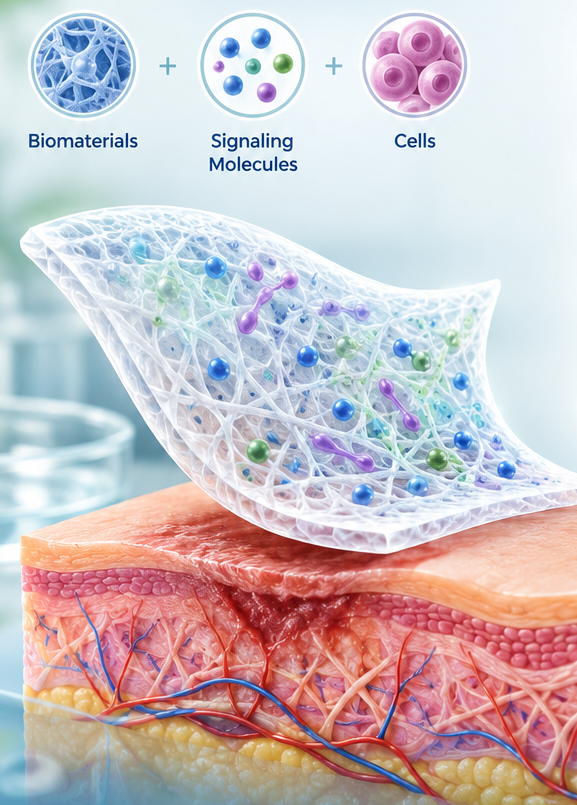
Deep skin injuries typically result in scar formation due to dysregulated healing, yet conventional split-thickness skin grafts remain limited by donor site scarcity and high rates of hypertrophic scarring. Bioengineered skin substitutes now offer a targeted solution by intervening directly in the fibrotic cascade through biomimetic extracellular matrix scaffolds that organize collagen deposition, pro-angiogenic designs that mitigate hypoxia-driven fibrosis, immunomodulatory strategies that promote reparative macrophage polarization, and mesenchymal stem cells that suppress TGF-β signaling via paracrine mechanisms. Clinical trials, particularly those evaluating autologous dermo-epidermal constructs such as denovoSkin™, have demonstrated superior outcomes over standard grafts, including significantly reduced scar thickness, better skin elasticity, and improved aesthetic results at one-year follow-up. While challenges in scalability, manufacturing cost, vascular and neural integration, and regulatory approval persist, emerging technologies like 3D bioprinting, smart drug-releasing scaffolds, and exosome-based therapies are poised to overcome these hurdles, making clinically meaningful, near-scarless skin regeneration an increasingly tangible reality.
References
Armato U, Freddi G. biomaterials for skin wound repair: tissue engineering, guided regeneration, and wound scarring prevention. Frontiers Media SA; 2021. p. 722327.
Metcalfe AD, Ferguson MW. Bioengineering skin using mechanisms of regeneration and repair. Biomaterials. 2007;28(34):5100-13.
Yin J, Zhang S, Yang C, Wang Y, Shi B, Zheng Q, et al. Mechanotransduction in skin wound healing and scar formation: potential therapeutic targets for controlling hypertrophic scarring. Frontiers in Immunology. 2022;13:1028410.
Sen CK. Human wound and its burden: Updated 2025 compendium of estimates. SAGE Publications Sage CA: Los Angeles, CA; 2025. p. 429-38.
Kemme FM, Pijpe A, Stoop MM, van Zuijlen PP, Meuli M, Schiestl C, et al. Safety and efficacy of bio-engineered, autologous dermo-epidermal skin grafts in reconstructive surgery: 1-year results of a prospective, randomized, intra-patient controlled, multicenter phase II clinical trial. Journal of Tissue Engineering. 2026;17:20417314261429663.
Meuli M, Schiestl C, Hartmann-Fritsch F, Middelkoop E, Kim B-S, Neuhaus K, et al. Safety and efficacy of bio-engineered, autologous dermo-epidermal skin grafts in adolescent and adult burn patients: 1-year results of a prospective, randomized, controlled, multicenter phase IIB clinical trial. EClinicalMedicine. 2025;90.
RV S. A review of tissueengineered skin bioconstructs available for skin reconstruction. JR Soc Interface. 2010;7:229-58.
Corr DT, Hart DA. Biomechanics of scar tissue and uninjured skin. Advances in wound care. 2013;2(2):37-43.
Urciuolo F, Passariello R, Imparato G, Casale C, Netti PA. Bioengineered wound healing skin models: The role of immune response and endogenous ECM to fully replicate the dynamic of scar tissue formation in vitro. Bioengineering. 2022;9(6):233.
Nour S, Imani R, Chaudhry GR, Sharifi AM. Skin wound healing assisted by angiogenic targeted tissue engineering: A comprehensive review of bioengineered approaches. Journal of Biomedical Materials Research Part A. 2021;109(4):453-78.
Urciuolo F, Casale C, Imparato G, Netti PA. Bioengineered skin substitutes: the role of extracellular matrix and vascularization in the healing of deep wounds. Journal of clinical medicine. 2019;8(12):2083.
Vaporidou N, Peroni F, Restelli A, Jalil MN, Dye JF. Artificial Skin Therapies; Strategy for Product Development. Advances in Wound Care. 2023;12(10):574-600.
Mulholland EJ. Electrospun biomaterials in the treatment and prevention of scars in skin wound healing. Frontiers in Bioengineering and Biotechnology. 2020;8:481.
Zheng Z, Zhang H, Yang J, Liu X, Chen L, Li W, et al. Recent advances in structural and functional design of electrospun nanofibers for wound healing. Journal of Materials Chemistry B. 2025;13(18):5226-63.
Rademakers T, Horvath JM, van Blitterswijk CA, LaPointe VL. Oxygen and nutrient delivery in tissue engineering: Approaches to graft vascularization. Journal of tissue engineering and regenerative medicine. 2019;13(10):1815-29.
Dean J, Hoch C, Wollenberg B, Navidzadeh J, Maheta B, Mandava A, et al. Advancements in bioengineered and autologous skin grafting techniques for skin reconstruction: a comprehensive review. Frontiers in Bioengineering and Biotechnology. 2025;12:1461328.
Shen L, Zhou Y, Gong J, Fan H, Liu L. The role of macrophages in hypertrophic scarring: molecular to therapeutic insights. Frontiers in Immunology. 2025;16:1503985.
Girela M, Gupta D, Grattoni A, Chua CYX. Targeted immunomodulation for chronic diseases through advanced delivery platforms. Expert opinion on drug delivery. 2026;23(2):295-311.
Whitaker R, Hernaez-Estrada B, Hernandez RM, Santos-Vizcaino E, Spiller KL. Immunomodulatory biomaterials for tissue repair. Chemical reviews. 2021;121(18):11305-35.
Alvites R, Branquinho M, Sousa AC, Lopes B, Sousa P, Maurício AC. Mesenchymal stem/stromal cells and their paracrine activity—immunomodulation mechanisms and how to influence the therapeutic potential. Pharmaceutics. 2022;14(2):381.
Formigli L, Paternostro F, Tani A, Mirabella C, Quattrini Li A, Nosi D, et al. MSCs seeded on bioengineered scaffolds improve skin wound healing in rats. Wound Repair and Regeneration. 2015;23(1):115-23.
Markeson D, Pleat JM, Sharpe JR, Harris AL, Seifalian AM, Watt SM. Scarring, stem cells, scaffolds and skin repair. Journal of tissue engineering and regenerative medicine. 2015;9(6):649-68.
Ramakrishnan R, Chouhan D, Vijayakumar Sreelatha H, Arumugam S, Mandal BB, Krishnan LK. Silk fibroin-based bioengineered scaffold for enabling hemostasis and skin regeneration of critical-size full-thickness heat-induced burn wounds. ACS Biomaterials Science & Engineering. 2022;8(9):3856-70.
Primous NR, Elvin PT, Carter KV, Andrade HL, La Fontaine J, Shibuya N, et al. Bioengineered skin for diabetic foot ulcers: A scoping review. Journal of Clinical Medicine. 2024;13(5):1221.
Chogan F, Chen Y, Wood F, Jeschke MG. Skin tissue engineering advances in burns: a brief introduction to the past, the present, and the future potential. Journal of burn care & research: official publication of the American Burn Association. 2022;44(Suppl 1):S1.
Ghalamghash R. Bioengineered Skin Substitutes in Aesthetic Reconstruction: Patient-Centered Applications. 2025.
Llames SG, Del Rio M, Larcher F, García E, García M, Escamez MJ, et al. Human plasma as a dermal scaffold for the generation of a completely autologous bioengineered skin. Transplantation. 2004;77(3):350-5.
Zhang X, Hao R, Tong J, Hu H, Du J, Gong B, et al. A radially aligned nanofiber scaffold with engineered guidance gradients for directed cell migration and accelerated wound healing. Biomaterials. 2025:123797.
Dash BC, Xu Z, Lin L, Koo A, Ndon S, Berthiaume F, et al. Stem cells and engineered scaffolds for regenerative wound healing. Bioengineering. 2018;5(1):23.
Qin J, Chen F, Wu P, Sun G. Recent advances in bioengineered scaffolds for cutaneous wound healing. Frontiers in Bioengineering and Biotechnology. 2022;10:841583.
Chang M, Nguyen TT. Strategy for treatment of infected diabetic foot ulcers. Accounts of chemical research. 2021;54(5):1080-93.
Kondej K, Zawrzykraj M, Czerwiec K, Deptuła M, Tymińska A, Pikuła M. Bioengineering skin substitutes for wound management—perspectives and challenges. International Journal of Molecular Sciences. 2024;25(7):3702.
Zhang J-K, Zhang Z-J, Shi F-T, Han Y-Y, Chen X-L, Fang X. Skin grafting and regeneration: Bridging biological barriers towards functional regeneration. Burns. 2026:108142.
Escámez MJ, Martínez-Santamaría La, García M, Guerrero-Aspizua S, Carretero M, Larcher F, et al. Bioengineered skin. Skin Biopsy: Perspectives; Khopkar, U, Ed; InTech: London, UK. 2011:261-96.
Schiestl C, Neuhaus K, Meuli M, Farkas M, Hartmann-Fritsch F, Elrod J, et al. Long-term outcomes of a cultured autologous dermo-epidermal skin substitute in children: 5-year results of a phase I clinical trial. Journal of Burn Care & Research. 2025;46(2):326-34.
Mahajan N, Soker S, Murphy SV. Regenerative medicine approaches for skin wound healing: from allografts to engineered skin substitutes. Current Transplantation Reports. 2024;11(4):207-21.
Mathur V, Agarwal P, Kasturi M, Srinivasan V, Seetharam RN, Vasanthan KS. Innovative bioinks for 3D bioprinting: Exploring technological potential and regulatory challenges. Journal of tissue engineering. 2025;16:20417314241308022.
Tavakoli S, Klar AS. Bioengineered skin substitutes: advances and future trends. Applied Sciences. 2021;11(4):1493.
Fortunate AA. Bioengineered skin for burn victims: advances and challenges. biomaterials. 2024;11:12.
Yang L, Lv Y. Noncoding RNAs in chronic wound healing: Mechanisms, exosome therapeutics, and translational frontiers. Journal of Tissue Engineering. 2026;17:20417314251410000.
Downloads
Published
How to Cite
Issue
Section
License
Copyright (c) 2026 The Journal of Applied Tissue Engineering

This work is licensed under a Creative Commons Attribution-NonCommercial-NoDerivatives 4.0 International License.
