Stem Cell-Based Therapies for Scarless Skin Repair
DOI:
https://doi.org/10.22034/JATE.2026.227Keywords:
Scarless wound healing , ; Skin regeneration, Scarless wound healing, ; Stem cell therapyAbstract
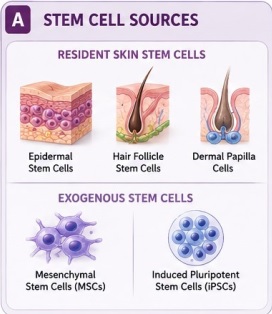
Scar formation after skin injury remains a significant clinical problem, affecting millions of people each year with important aesthetic, functional and economic sequelae. Mammalian fetal skin regenerates in a scarless manner until about 24 weeks gestation, unlike adult wound healing where it results in avascular, disorganized scar formation, thus providing a developmental model for adult repair. This review summarizes recent advances in stem cell-based therapy for scarless skin regeneration, including cutaneous stem cell niches (EpSCs, HFSCs, MSCs, ASCs), key signaling pathways (Wnt/β-catenin, YAP, TGF-β/Smad), and novel strategies such as extracellular vesicles and biomaterial-assisted delivery. Preclinical studies have demonstrated the ability of stem cell transplantation to improve wound healing by accelerating wound closure, increasing vascularization and modulating inflammation. Nevertheless, issues of reproducibility, standardization, and inadequate preclinical model systems limit their use in the clinic. Future integration of genome editing, organoids, bioprinting and multi-omics will fill this gap. Overall, stem cell-based approaches represent a paradigm shift from passive anti-fibrosis to active regeneration, with transformative potential for functional skin restoration.
References
Huang Y, Wu X, Xu Y, Yang N, Xi P, Wang Y, et al. Organoids/organs-on-chips towards biomimetic human artificial skin. Burns & Trauma. 2025;13:tkaf029.
Teertam SK, Setaluri V, Ayuso JM. Advances in microengineered platforms for skin research. JID Innovations. 2025;5(1):100315.
Yang Y, Cheng Q, Hu Y, Zhang Y, Ran N, Yang J, et al. Spatiotemporal immunomodulation by engineered hair follicle stem cell-derived nanovesicles enables scarless regeneration of infected wounds. Chemical Engineering Journal. 2026:172657.
Panda D, Nayak S. Stem cell-based tissue engineering approaches for diabetic foot ulcer: a review from mechanism to clinical trial. Stem cell reviews and reports. 2024;20(1):88-123.
Chai H, Wang Z, Ju J, Sun J. Multifunctional hydrogel‐based wound dressings for scar‐free healing: Design principles, therapeutic mechanisms, and clinical translation challenges. Advanced NanoBiomed Research. 2026;6(1):e202500147.
Wang X, Xu Z, Lv Y, Xiang D. Mesenchymal Stem Cells-Derived Exosomes: Next-Generation Nanomedicines Toward Scarless Wound Healing. International Journal of Nanomedicine. 2026:586955.
Fu M, Huang Z, Li J, Li Y, Fang Z, Jiang Y, et al. Approaching Scarless Wound Healing: From Passive Anti‐Fibrotic to Proactive and Programmable Pro‐Regenerative Strategies. Advanced Science. 2026;13(18):e21824.
Cao X, Wu X, Zhang Y, Qian X, Sun W, Zhao Y. Emerging biomedical technologies for scarless wound healing. Bioactive materials. 2024;42:449-77.
Kosykh AV, Zhigmitova EB, Evtushenko NA, Gurskaia TH, Martynova AA, Silaeva YY, et al. Restoring Ag1, an ancient regeneration gene lost in amniotes, accelerates skin healing in mice. Frontiers in Cell and Developmental Biology. 2026;14:1706902.
Huang L, Ye X, Zhang Y, Ho C-K, Li Q. Impact of different mating and surgical protocols on the establishment of a mouse model for fetal scarless skin healing. Biological Procedures Online. 2025;27(1):38.
Gomes MLNP, Krijnen PA, Middelkoop E, Niessen HW, Boekema BK. Fetal skin wound healing: key extracellular matrix components and regulators in scarless healing. Journal of Investigative Dermatology. 2025;145(2):280-302.
Agramunt J, Kang Y, Rinkevich Y. Spatiotemporal dynamics of mammalian wound healing. Cell Discovery. 2026;12(1):4.
Zheng Z, Ha P, Li C, Chang GX, Jiang W, Pang X, et al. Preclinical Efficacy and Safety Study of a Novel Dermal Fibroblast Modulating Drug, SLI‐F06, in Cutaneous Wound Healing. MedComm. 2026;7(6):e70761.
Fang R, Hamaguchi R, Xu S, Lee W, Todorova K, Sol S, et al. Rete ridge topography as a determinant of epidermal stem cell identity: Implications for skin aging. bioRxiv. 2026:2026.04. 07.716516.
Jiang Z, Xu Y, Lou Y. From a stem-cell–centered to a niche-centered view: the core role of collagen networks in hair loss and hair follicle miniaturization. Frontiers in Cell and Developmental Biology. 2026;14:1824126.
Tumbar T, Ganguly T, McMahon CE, Tavallaei MA. Vascular endothelial cells as signaling niches for epithelial stem cells in the skin. Frontiers in Cell and Developmental Biology. 2026;14:1781544.
Dimri-Wagh S, Bhattacharya S, Yassen G, Shorer O, Amitai-Lange A, Altshuler A, et al. Aged differentiated cells reverse into native stemness-like state by niche cytokines to sustain lifelong homeostasis and tissue repair. Nature Communications. 2026.
Lei R, Li G, Li N, Lin S, Chen Q, Yu X, et al. Adult stem cell therapy for skin wound healing: A translational perspective from bench to bedside. Regenesis Repair Rehabilitation. 2026.
Niti A, Kouzi-Koliakou K, Michopoulou A. Fibroblast Lineage Switching as the Developmental Origin of Scarring and Target for Regenerative Healing. Biology. 2026;15(5):409.
Kang Y, Yang Y, Yao B, Zhang Z, Ji X, editors. Scar inhibition in wound healing: Mechanisms, design, and recent advances. Exploration; 2026: Wiley Online Library.
Elakkawi MM, Zhu Y, Xiong Y, Li C, Li H, Chen J, et al. Study on the mechanism of hUCMSCs-derived 3D exosome combined with HAMA microneedles in the treatment of deep second-degree burns. Bioactive Materials. 2026;56:468-82.
Miranda J, Maestre N, Devia M, Zapata R, Ochoa-Díaz MM, Annicchiarico W. Inflammation at the Maternal–Fetal Interface: Mechanisms Linking Maternal–Fetal Immunity to Preeclampsia and Fetal Growth Restriction. International Journal of Molecular Sciences. 2026;27(9):3954.
Choudhery MS, Arif T, Mahmood R. Aging puzzle: A closer look on the complex dilemma of autologous stem cell therapy. World Journal of Stem Cells. 2026;18(1):114119.
Xue Y, Lin Y, Lu Y, Zhang H, Chen B, Zhao Y, et al. Sprayable polysaccharide-based biomimetic double dressing with synergistic regulation for wound healing. Biomaterials. 2026:124328.
Jeyaraman N, Roy M, Muthu S, Khan S, Jeyaraman M. Preclinical Insights into Wound Healing: models, Mechanisms, and Translational Strategies. Management and Strategies for Wound Healing: Springer; 2026. p. 287-309.
Gultepe E, Valluru R, Brown NB, Sridhar S. The landscape of nanomedical clinical trials. Nano Today. 2026;66:102898.
Liao Z, Chen X, Hirt-Burri N, Porcello A, Marques C, Lourenço K, et al. Pharmacological and Biological Strategies as Regulators of Scarless Wound Healing and Regeneration of Skin. 2025.
Ceylan S, Demir D, Harris C, İpek SL, Vavourakis V, Manca M, et al. Skin in the game: a review of computational models of the skin. BioData Mining. 2025;18(1):55.
Zhang M, Zhang C, Li Z, Fu X, Huang S. Advances in 3D skin bioprinting for wound healing and disease modeling. Regenerative biomaterials. 2023;10:rbac105.
Biglari S, Le TY, Tan RP, Wise SG, Zambon A, Codolo G, et al. Simulating inflammation in a wound microenvironment using a dermal wound‐on‐a‐chip model. Advanced healthcare materials. 2019;8(1):1801307.
Gao Z, Xu J, Zhao H, Zheng X, Lyu Z, Liu Q, et al. A microfluidic system for real-time monitoring and in situ metabolite detection of plasma-enhanced wound healing. Biomolecules. 2025;15(8):1077.
Downloads
Published
How to Cite
Issue
Section
License
Copyright (c) 2026 The Journal of Applied Tissue Engineering

This work is licensed under a Creative Commons Attribution-NonCommercial-NoDerivatives 4.0 International License.
