Biomaterials and scaffolds that promote regenerative rather than fibrotic healing
DOI:
https://doi.org/10.22034/JATE.2026.215Keywords:
scarless wound healing, biomaterial scaffolds, anti-fibroticAbstract
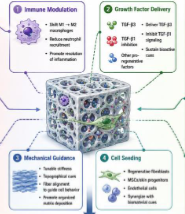
Wound healing after dermal wounding is a major clinical problem and for adult skin, healing reverts to fibrotic repair, which involves an excess of collagen deposition and an activation of myofibroblasts. Embryonic skin, on the other hand, quickly regenerates without scarring, with tightly regulated immune responses and balanced cytokine signaling. The biomaterial scaffolds have been developed to become active therapeutic platforms that can alter the course of the wound from fibrosis to regeneration by mimicking essential microenvironmental signals. Scaffold design principles (architecture, porosity, stiffness, and surface topography) are discussed and natural and synthetic biomaterials are reviewed for their ability to induce regeneration associated phenotypes. We highlight immune-modulatory strategies which switch macrophages to pro-resolving phenotypes and inhibit fibrotic cascade. In addition to state of the art fabrication technologies like 3D bioprinting and electrospinning, advanced biofunctionalization strategies like sustained delivery of anti-fibrotic growth factors, miRNA therapeutics and cell-seeded constructs are also critically evaluated. Preliminary data have shown that strategically designed scaffolds can markedly decrease scar index and restore skin appendages. Lastly, we discuss translational issues and trends for personalized, phase-dependent responsive scaffolds. This analysis emphasizes that biomaterial-directed regeneration is a pedagogic therapeutic model that can revolutionize scar management in the clinical practice.
References
Metcalfe, A., & Ferguson, M. (2007). Tissue engineering of replacement skin: the crossroads of biomaterials, wound healing, embryonic development, stem cells and regeneration. Journal of The Royal Society Interface, 4, 413–437. https://doi.org/10.1098/rsif.2006.0179
Tottoli, E. M., Dorati, R., Genta, I., Chiesa, E., Pisani, S., & Conti, B. (2020). Skin Wound Healing Process and New Emerging Technologies for Skin Wound Care and Regeneration. Pharmaceutics, 12. https://doi.org/10.3390/pharmaceutics12080735
Monavarian, M., Kader, S., Moeinzadeh, S., & Jabbari, E. (2019). Regenerative Scar-Free Skin Wound Healing. Tissue Engineering Part B: Reviews, 25, 294–311. https://doi.org/10.1089/ten.teb.2018.0350
Weng, T., Zhang, L., Liu, Y., Zhao, X., & Yue, X. (2025). Advances in Tissue Engineering and Biomaterials for Minimizing Wound Scarring: Current Status and Future Challenges. Journal of Functional Biomaterials, 17. https://doi.org/10.3390/jfb17010003
Butenko, S., Miwa, H., Liu, Y., Plikus, M., Scumpia, P., & Liu, W. F. (2022). Engineering Immunomodulatory Biomaterials to Drive Skin Wounds toward Regenerative Healing. Cold Spring Harbor Perspectives in Biology. https://doi.org/10.1101/cshperspect.a041242
Griffin, D., Archang, M. M., Kuan, C.-H., Weaver, W., Weinstein, J., Feng, A.-C., Ruccia, A. R., Sideris, E., Ragkousis, V., Koh, J., Plikus, M., Di Carlo, D., Segura, T., & Scumpia, P. (2020). Activating an adaptive immune response from a hydrogel scaffold imparts regenerative wound healing. Nature Materials, 20, 560–569. https://doi.org/10.1038/s41563-020-00844-w
Dickinson, L. E., & Gerecht, S. (2016). Engineered Biopolymeric Scaffolds for Chronic Wound Healing. Frontiers in Physiology, 7. https://doi.org/10.3389/fphys.2016.00341
Downer, M., Berry, C., Parker, J. B. L., Kameni, L. E., & Griffin, M. (2023). Current Biomaterials for Wound Healing. Bioengineering, 10. https://doi.org/10.3390/bioengineering10121378
Qin, J., Chen, F., Wu, P., & Sun, G. (2022). Recent Advances in Bioengineered Scaffolds for Cutaneous Wound Healing. Frontiers in Bioengineering and Biotechnology, 10. https://doi.org/10.3389/fbioe.2022.841583
Arabpour, Z., Abedi, F., Salehi, M., Baharnoori, S. M., Soleimani, M., & Djalilian, A. (2024). Hydrogel-Based Skin Regeneration. International Journal of Molecular Sciences, 25. https://doi.org/10.3390/ijms25041982
Zahid, A. A., Chakraborty, A., Shamiya, Y., Ravi, S., & Paul, A. (2022). Leveraging the advancements in functional biomaterials and scaffold fabrication technologies for chronic wound healing applications. Materials Horizons. https://doi.org/10.1039/d2mh00115b
Li, Y.-Y., Ji, S.-F., Fu, X., Jiang, Y.-F., & Sun, X.-Y. (2024). Biomaterial-based mechanical regulation facilitates scarless wound healing with functional skin appendage regeneration. Military Medical Research, 11. https://doi.org/10.1186/s40779-024-00519-6
Rahmati, M., Blaker, J., Lyngstadaas, S., Mano, J., & Haugen, H. (2020). Designing multigradient biomaterials for skin regeneration. Materials Today, 5, 100051. https://doi.org/10.1016/j.mtadv.2019.100051
Fan, L., Dong, W., Lu, J., Peng, Y., Xie, B., Wei, P., Jiang, M., & Chen, S. (2025). Robust Controlled Degradation of Enzyme Loaded PCL-Based Fibrous Scaffolds Toward Scarless Skin Tissue Regeneration. Advanced Science, 12. https://doi.org/10.1002/advs.202501053
Xiong, M., Yang, X., Shi, Z., Xiang, J., Gao, H., Ji, S.-F., Li, Y., Pi, W., Chen, H., Zhang, H., Wang, M., Li, Y., Hong, Y., Liu, D., Fu, X., Dong, Y., & Sun, X. (2024). Programmable Artificial Skins Accomplish Antiscar Healing with Multiple Appendage Regeneration. Advanced Materials, 36. https://doi.org/10.1002/adma.202407322
Fu, M., Huang, Z., Li, J., Li, Y., Fang, Z., Jiang, Y., Wu, K., & Guo, J. (2026). Approaching Scarless Wound Healing: From Passive Anti-Fibrotic to Proactive and Programmable Pro-Regenerative Strategies. Advanced Science, 13. https://doi.org/10.1002/advs.202521824
Cao, Y., Sun, J., Qin, S., Zhou, Z., Xu, Y., & Liu, C. (2024). Advances and Challenges in Immune-Modulatory Biomaterials for Wound Healing Applications. Pharmaceutics, 16. https://doi.org/10.3390/pharmaceutics16080990
Corduff, N. (2023). Introducing aesthetic regenerative scaffolds: An immunological perspective. Journal of Cosmetic Dermatology, 22, 14–8. https://doi.org/10.1111/jocd.15702
Liu, X., Li, Z., Liu, L., Hu, Y., Xiong, Y., Lu, Y., Bie, F., Chen, S., Zhou, F., Xu, Y., Qi, S., & Chen, L. (2024). 3D-printed biomimetic scaffold with liposome-encapsulated SB431542 promotes scarless wound healing. Journal of Materials Science & Technology. https://doi.org/10.1016/j.jmst.2024.04.046
Zhang, J., Zheng, Y., Lee, J., Hua, J., Li, S., Panchamukhi, A., Yue, J., Gou, X., Xia, Z., Zhu, L., & Wu, X. (2021). A pulsatile release platform based on photo-induced imine-crosslinking hydrogel promotes scarless wound healing. Nature Communications, 12. https://doi.org/10.1038/s41467-021-21964-0
Li, X., Zhang, K.-W., Zhang, Z.-Y., Wu, J.-J., Yuan, Z.-D., Yuan, F.-L., & Chen, J. (2024). Inhibiting dipeptidyl peptidase 4 positive fibroblasts using zinc sulfide cellulose nanofiber scaffolds to achieve scarless healing. International Journal of Biological Macromolecules, 137525. https://doi.org/10.1016/j.ijbiomac.2024.137525
Gansevoort, M., Wentholt, S., Vecchi, G. L., De Vries, M., Versteeg, E. M. M., Boekema, B., Choppin, A., Barritault, D., Chiappini, F., Van Kuppevelt, T. V., & Daamen, W. (2025). Next-Generation Biomaterials for Wound Healing: Development and Evaluation of Collagen Scaffolds Functionalized with a Heparan Sulfate Mimic and Fibroblast Growth Factor 2. Journal of Functional Biomaterials, 16. https://doi.org/10.3390/jfb16020051
Wu, P., Liang, Y., & Sun, G. (2021). Engineering immune-responsive biomaterials for skin regeneration. Biomaterials Translational, 2, 61–71. https://doi.org/10.3877/cma.j.issn.2096-112x.2021.01.008
Chen, L., Zhang, L., Zhang, H., Sun, X., Liu, D., Zhang, J., Zhang, Y., Cheng, L., Santos, H., & Cui, W. (2021). Programmable immune activating electrospun fibers for skin regeneration. Bioactive Materials, 6, 3218–3230. https://doi.org/10.1016/j.bioactmat.2021.02.022
Yang, Y., Chu, C.-Y., Man, Y., Liu, L., Wang, C., & Qu, Y. (2023). Tracing immune cells around biomaterials with spatial anchors during large-scale wound regeneration. Nature Communications, 14. https://doi.org/10.1038/s41467-023-41608-9
Yang, Y., Kuang, M., Shi, J., Li, R., Zhang, Y., Liu, X., Li, R., Kang, Y., Yao, B., Zhang, S., & Ji, X. (2026). Promoting Treg Polarization-Mediated Anti-Scar and Appendage Regeneration in Wound Healing. Advanced Science, 13. https://doi.org/10.1002/advs.202510815
Zhong, S., Zhang, Y., & Lim, C. (2010). Tissue scaffolds for skin wound healing and dermal reconstruction. Wiley Interdisciplinary Reviews: Nanomedicine and Nanobiotechnology, 2(5), 510–525. https://doi.org/10.1002/wnan.100
Zhang, F., Zhang, H., Wang, S., Gao, M., Du, K., Chen, X., Lu, Y., Hu, Q., Du, A., Du, S., Wang, J., Shi, K., Chen, Z., Li, Z., Li, Z., & Xiao, J.-F. (2025). A dynamically phase-adaptive regulating hydrogel promotes ultrafast anti-fibrotic wound healing. Nature Communications, 16. https://doi.org/10.1038/s41467-025-58987-w
Zhang, X., Hao, R., Tong, J., Hu, H., Du, J., Gong, B., Tian, F., Lu, Y., & Xue, J. (2025). A radially aligned nanofiber scaffold with engineered guidance gradients for directed cell migration and accelerated wound healing. Biomaterials, 327, 123797. https://doi.org/10.1016/j.biomaterials.2025.123797
Ghosh, S., Haldar, S., Gupta, S., Chauhan, S., Mago, V., Roy, P., & Lahiri, D. (2022). Single unit functionally graded bioresorbable electrospun scaffold for scar-free full-thickness skin wound healing. Biomaterials Advances, 139, 212980. https://doi.org/10.1016/j.bioadv.2022.212980
Ramakrishnan, R., Chouhan, D., Sreelatha, H. V., Arumugam, S., Mandal, B., & Krishnan, L. (2022). Silk Fibroin-Based Bioengineered Scaffold for Enabling Hemostasis and Skin Regeneration of Critical-Size Full-Thickness Heat-Induced Burn Wounds. ACS Biomaterials Science & Engineering. https://doi.org/10.1021/acsbiomaterials.2c00328
Krymchenko, R., Avila-Martinez, N., Gansevoort, M., Bakker, G., Gomes, M. L., Vlig, M., Versteeg, E. M. M., Boekema, B., Van Kuppevelt, T. V., & Daamen, W. (2025). Collagen-elastin dermal scaffolds enhance tissue regeneration and reduce scarring in preclinical models. Materials Today Bio, 34. https://doi.org/10.1016/j.mtbio.2025.102239
Downloads
Published
How to Cite
Issue
Section
License
Copyright (c) 2026 The Journal of Applied Tissue Engineering

This work is licensed under a Creative Commons Attribution-NonCommercial-NoDerivatives 4.0 International License.
